

Every other day, organizations are coming up with new products, which take months and even years to develop. Now imagine after a long period of hard work and patience, finally the D day has come, and the release of the first version is near. The stakes are high, and people are nervous but confident, too, about the quality of work. The applications come out as great; however, human error can override perfection, and the app is riddled with bugs. These bugs make users dissatisfied and come up with unforgiving reviews. And this is why software testing is important. We will look at the software testing basics and their other aspects to perform in the best possible manner.
Introduction to Software Testing
Software Testing is a process to verify and validate whether the launched products or applications are working as expected or not. It is done to identify any gaps, errors and bugs that can affect the performance of an application.
Testing is done before launching the product in the market to understand its various aspects and thoroughly examine each one. The process is professionally done by combining manual testing with automated tools.
After running tests, testers send the reports to the development team. To fulfill the end goal of delivering a quality product.
Two Main Steps in Software Testing
- Verification: A step to figure out that the software is doing what it is made for. Is the product being built the right way?
- Validation: It is about verifying that the software is meeting the consumer’s expectations or not. Is the right product being made?
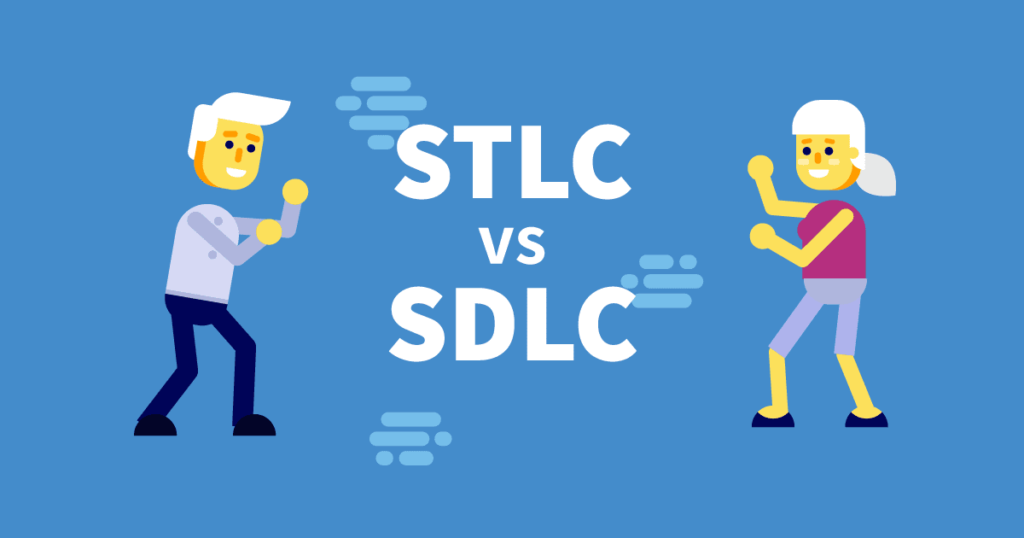
STLC vs SDLC
| Aspect | Software Development Life Cycle (SDLC) | Software Testing Life Cycle (STLC) |
|---|---|---|
| Definition | It is a process that includes all phases of software development, from gathering requirements to deployment and maintenance. | STLC encompasses all processes during software testing, from requirement analysis to test closure. |
| Focus | It is about building software. | It is about verifying and validating the software. |
| Phases | It starts with project requirements. Consists of design, development, testing, deployment and maintenance. | It starts when project requirements are defined. Consists of requirement analysis, test planning, test case development, test environment setup, test execution, test closure. |
| Worked by | Developers, business analysts, project managers, QA team. | Primarily by the QA/testing team. |
| Documentation | Software product, design documents, user manuals, deployment package. | Test plan, test cases. |
| Objectives | Deliver a software product that caters to user needs. | Ensure a detect-free and high quality product before release. |
| Relation | Covers the entire lifecycle of the software. | It is testing focused, covers part of SDLC. |
Phases of the Software Testing Lifecycle
Requirement Analysis → Test Planning → Test Case Development → Test Environment Setup → Test Execution → Test Closure
Types of Software Testing
1. Manual Testing
Manual testing involves checking the defect one by one by trying each and every function manually, whether it is working as expected or not. The software is tested using the features of an application.
2. Automation Testing
This is another main category of software testing, where Testers write scripts independently, and suitable software or automation tools are used for testing. It is an automation of a manual process to execute repetitive tasks without the use of a Manual Tester.
Basic Software Testing Techniques
We will talk about two main types of testing. Functional testing is where a system or application is verified to behave as expected and serve the specified demand. It is more about the user’s perspective.
Whereas, Non-Functional testing refers to evaluating the overall quality of the system, including performance, security, usability, scalability, and reliability, so that the systems are well capable of handling real-world scenarios in various conditions.
Types of Functional Testing
1. Integration Testing
It is an essential type of testing when different modules are built by different teams. It is done to ensure smooth working without conflicts between systems built with microservices.
2. Regression Testing
Regression testing is done after the codebase is changed to fix bugs or enhance features. It is done to ensure that existing overall functionality remains unaffected and stability is preserved. The integrity of the software is maintained throughout continuous development.
3. Sanity Testing
As the name suggests, it verifies the correctness of recent software changes. It ensures core functionality remains the same before the application proceeds to deeper testing stages. It is usually done after receiving a new build, focused only on the modified and fixed areas.
There are also many other types of functional testing, such as unit testing, component testing, system testing, and smoke testing.
Types of Non-Functional Testing
1. Performance Testing
It calculates the efficiency of software application performance under expected conditions. Key metrics like loading speed, crash frequency, memory usage, response time, and CPU consumption.
2. Stress Testing
Under this test, the systems are pushed beyond normal operating limits to understand their behavior under extreme conditions. It helps to identify the breaking point and recovery capability from crashes or failures of the application.
3. Load Testing
It checks how a system handles increased user activity or demand, such as multiple logins or simultaneous transactions. By these tests, it is helpful in identifying bottlenecks and keeping the applications stable and responsive under normal and peak usage.
The other types of non-functional testing include responsive testing, scalability testing, visual testing, and security testing.
Quality Assurance vs Software Testing
Quality assurance is about keeping a check on the process used to build the software, whereas software testing is about finding defects in the final software product.
| Aspect | Quality Assurance | Software Testing |
|---|---|---|
| Focus | Process | Product |
| Objective | Prevent defects | Find defects |
| Nature | Proactive | Reactive |
| Scope | Entire SDLC | Testing phase only |
| When it Starts | It starts when the project begins | It starts after the development starts |
| Responsibility | QA team and stakeholders | Testers / QA engineers |
| Techniques | Process reviews, audits | Manual & automation testing |
| Examples | Setting testing standards | Running login test cases |
Conclusion
As per IBM research, untested applications are 70% more prone to security breaches, and the breach costs reach $4.45 million. Software testing is not just another technical step but an essential process that can directly impact quality, customer trust, which indeed affects company revenue. In this blog, we have discussed software testing basics and why it is important. Also, we saw how different types of testing methods are used as per the requirement.
Get your right testing strategies and turn good ideas into reliable products.